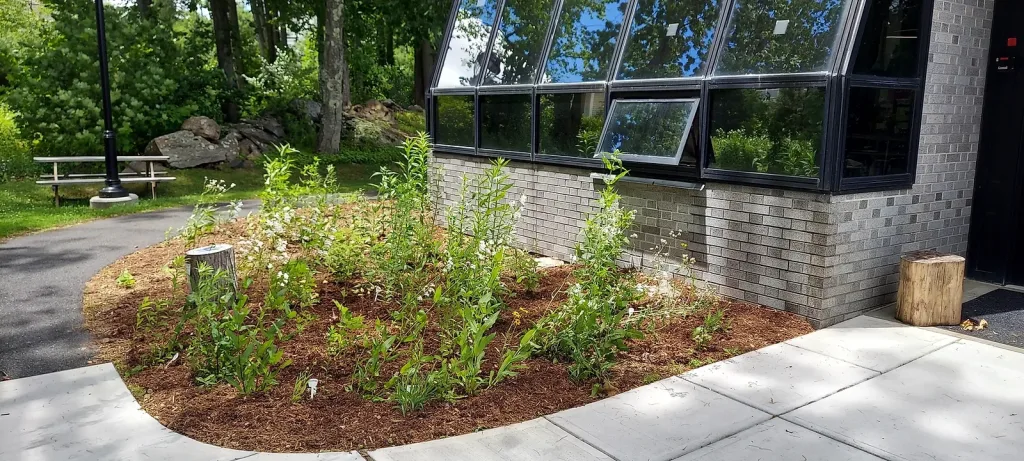



Community Pollinator Pathway projects are organized to establish pollinator-friendly habitat and food sources for bees, butterflies, hummingbirds and other pollinating insects and wildlife along a series of continuous corridors. Most native bees have a range of about 750 meters, so the goal is to connect properties that are no farther apart than that.
Without pollinators, we can’t feed ourselves. Pollination enables the plants in our yards, parks, farms and orchards to reproduce. Pollinator populations are in sharp decline because of pesticide use and loss of habitat.
Because the Pollinator Pathway “de-fragments” the environment, it benefits our ecosystem as a whole. Our landscape has been chopped up, or fragmented, through urban- and suburban-ization. If we begin to manage our own yards organically and with native plantings, we can use them to connect parks and preserves, creating crucial corridors for wildlife. That is the idea behind the Pollinator Pathway.
Why do native plants matter? Our local pollinators have evolved to depend on our local plants. Our caterpillars and bees can’t use trees from China and Japan. The monarch butterfly is a good example as it must have the milkweed plant to survive. Without the milkweed, there will be no monarchs, and we don’t typically put these “weeds” in our yards. They have also been eradicated from fields by farmers, and now the monarch is in danger of extinction.