

A gift with purchase is a free item or benefit a customer receives when they buy a qualifying product or reach a stated spend threshold. The best choice fits what they are buying, feels useful to them, and leaves enough margin for the business to run the offer again.
If you are planning a holiday promotion, start with the customer experience: what would make this purchase feel more thoughtful? A sample helps them try something new. An accessory helps them use what they bought. A tree planted on their behalf gives them a contribution to reforestation they can follow.
ForestNation helps businesses connect customer orders with tree planting in Tanzania. If that fits your campaign, see how to plant a tree with every order.
Key Takeaways
- Choose the gift and the qualifying rule together: every order, a selected product, a spend threshold, or a defined campaign period.
- Compare the full cost, including packaging, handling, shipping and returns, with the additional margin the offer produces.
- A physical gift, a digital benefit and a tree-planting contribution create different recipient experiences. Explain exactly what the customer receives.
- ForestNation customers use several planting models, including Image Source’s tree per order and Solution Group’s 100 trees for every €5,000 of client spend.
Which gift with purchase ideas fit your customers?
Start with a shortlist of gifts that belong alongside your product. These twelve options cover physical items, digital extras and contributions. They are planning ideas, with the practical checks you should make before committing to a campaign.
1. A complementary sample
Where it fits: Beauty, food or care products with a related range. Possible qualifying rule: First purchase or selected product. Check before launch: Ingredients, shelf life and sample availability.
2. A travel-size product
Where it fits: A compact version of something the customer uses. Possible qualifying rule: A qualifying basket total. Check before launch: Packaging cost and whether it fits the existing parcel.
3. A useful accessory
Where it fits: A brush with footwear, a cable organiser with electronics, or a scoop with coffee. Possible qualifying rule: Purchase of a matching product. Check before launch: Compatibility and the quality of the accessory.
4. A reusable pouch
Where it fits: Products customers carry or store together. Possible qualifying rule: A bundle or collection purchase. Check before launch: Size, material specification and decoration cost.
5. A refill or replacement part
Where it fits: A product designed for refilling or maintenance. Possible qualifying rule: An initial purchase or a repeat-order milestone. Check before launch: Fit, safe use and ongoing availability.
6. A printed recipe or activity set
Where it fits: Cooking, craft or family products. Possible qualifying rule: A relevant starter set. Check before launch: Original content and clear, usable instructions.
7. A digital guide or class
Where it fits: A purchase that benefits from advice or a demonstration. Possible qualifying rule: A selected product or category. Check before launch: Access instructions, support and any expiry date.
8. Personalisation
Where it fits: A product that can carry a name or short message. Possible qualifying rule: A qualifying order during a defined period. Check before launch: Production capacity, spelling approval and returns terms.
9. A small seasonal extra
Where it fits: A holiday order or gift bundle. Possible qualifying rule: A stated campaign window. Check before launch: Arrival date and a plan for unused stock.
10. A contribution to a named cause
Where it fits: A campaign with a clear charitable purpose. Possible qualifying rule: A fixed contribution per qualifying order. Check before launch: Recipient organisation, amount, campaign limits and evidence.
11. A tree planted on the customer’s behalf
Where it fits: A brand inviting customers to support reforestation. Possible qualifying rule: Every order, selected products or a spend threshold. Check before launch: Planting location, reporting and the message customers receive.
12. A branded Tree Kit
Where it fits: A physical order with room for a gift the recipient can grow. Possible qualifying rule: A selected bundle or seasonal campaign. Check before launch: Seed suitability, fulfilment, branding and growing instructions.
For a small budget, begin with something you already know how to source or deliver well. A sample from your own range may be easier to fulfil than a new custom product. A digital class may be a good fit if you already have the teaching and support capacity. Treat the recipient’s time as part of the decision: a gift should feel worth opening.
Personalisation and digital access are service benefits; a contribution funds work on the customer’s behalf. Describe each accurately in the offer. A shopper expecting an item in the parcel should know when the gift is delivered by email or represented by a contribution instead.
How should customers qualify for the gift?
Choose one clear rule that your checkout, fulfilment team and customer service team can explain consistently. The rule determines both the customer action and your exposure to gift costs.
- Every qualifying order: simple to communicate, with a cost attached to each eligible purchase. Useful when consistency is the point.
- A spend threshold: gives the customer a reason to consider a larger basket. Set the threshold using your order values and margins.
- A specific product or range: keeps the gift relevant to a launch, collection or category.
- A defined period: gives a seasonal campaign a clear start and end. Match the promise to stock and delivery capacity.
- A repeat-purchase milestone: recognises an existing relationship. Make the eligibility rules easy to check.
Free shipping and discounts are other incentives worth testing, but they serve a different job from a gift. Compare them against the same commercial target. If shipping cost is the main checkout objection, solving that may matter more to the buyer than adding an item.
For US offers, the FTC’s guidance on free offers says the terms for receiving and keeping the free item should be clear at the outset. Put the qualifying spend, exclusions, availability and relevant returns conditions beside the offer.
How much can you afford to spend on a gift with purchase?
Work backwards from the additional contribution margin you expect, then test whether the campaign earns it. Average order value alone cannot tell you whether the promotion is profitable.
Illustrative example, not a ForestNation price or client result: suppose an offer encourages a customer to increase an order from $60 to $80. At a 40% contribution margin on that extra $20, the additional contribution is $8 before the gift. If the gift, extra packing and handling cost $5 together, the order leaves $3 of additional contribution.
That calculation assumes the customer spends the extra $20 because of the offer. Customers who would already have spent $80 also receive the gift, and their gift costs still count. Returns, extra shipping charges and customer support can change the result.
- Include the gift’s landed cost, decoration, packaging and extra fulfilment time.
- Estimate how many orders will qualify naturally and how many the offer may change.
- Set a maximum campaign budget and monitor spend while it runs.
- Compare contribution after campaign costs with a similar period or a suitable control group.
A smaller test lets you check the economics and the delivery experience before placing a larger order. Use a real cost sheet. An attractive retail value printed beside the gift does not pay the fulfilment bill.
How have ForestNation customers linked gifts to purchases?
Our customers use planting in different ways. These examples show the campaign mechanisms, so you can decide which one fits your orders, customers and budget.
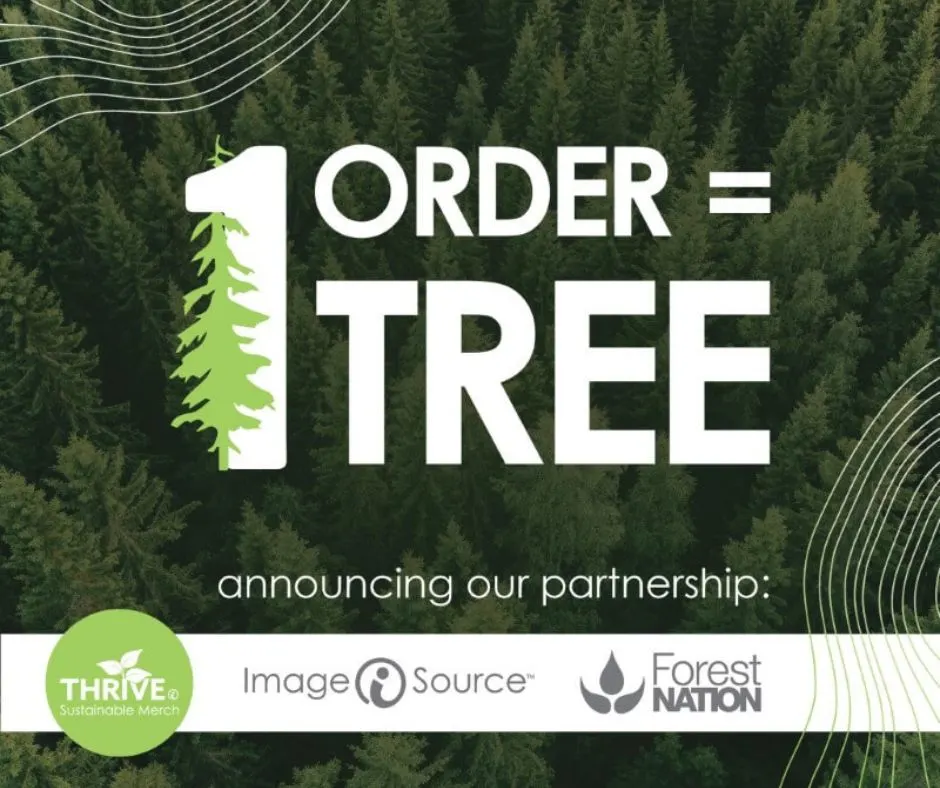
Image Source: a tree for every order
Image Source’s planting programme connects every order with a tree planted through ForestNation. The company also creates dedicated Forest Profiles for selected clients, including Microsoft and Mercedes-Benz.
The practical lesson is consistency: each order follows the same planting rule, and the Forest Profile gives the company a place to share the progress. ForestNation handles planting in Tanzania and the reporting behind it.
For background on the distributor market, see PPAI Top 100 Distributors.
Solution Group: planting linked to client spend
Solution Group’s programme, launched in 2021, plants 100 trees for every €5,000 a client spends. A spend-based model lets a company connect the contribution to the scale of the order.
What we are perceiving the most is the positioning of the Solution Group brand as a supplier amongst our customers. We are stuck in their minds as the company who does things differently and that will make their purchasing more meaningful.
Manuel Xueref, Marketing/CSR Director, Solution Group

Philips Monitors: a product-linked campaign
The Philips Monitors case study describes tree planting associated with monitor purchases and a campaign with distributor Galtec that used digital Gift Stories for corporate customers.
This gives them a major uptick in sales, with customers raving about the feel-good factor of knowing their new screen gives back!
The useful distinction here is the qualifying product. The campaign can explain which purchase funds planting and give the customer a way to view the story behind that contribution.

Brondell: a physical Tree Kit for a seasonal campaign
Every Earth Month, Brondell gifts branded Tree Kits to customers who place an order.
It’s been such a hit, they’ve kept the tradition going strong since 2022!
A physical Tree Kit gives the recipient seeds to plant and growing instructions to follow. Plan the packaging and delivery alongside the product it accompanies.

How do you add tree planting to a purchase campaign?
Choose the planting rule, prepare the customer message and agree how qualifying orders will be recorded. ForestNation can tailor the programme to your budget and the contribution you want to make.
- Choose the rule. Decide how many trees you will fund per order, per qualifying product, or at a defined level of spend.
- Prepare the customer experience. A branded Forest Profile shows the programme. QR codes can point to it, and a WePlant website badge shows planting supported through ForestNation. A Gift Story can carry a personal message by email.
- Confirm fulfilment and reporting. Plant through your Forest Profile or send a purchase order for invoicing. Agree any order-triggered messages and integration details before launch.
Keep the formats clear. A Tree Kit is a physical gift the recipient grows. Tree planting in Tanzania is funded work carried out through ForestNation. A digital Gift Story gives you a way to share a message and the planting story. Choose the combination that suits the purchase.
Our guide to planting a tree for every purchase explains the ongoing model. If you are deciding between a contribution attached to each purchase and points customers redeem later, compare tree planting and loyalty rewards. The ForestNation impact methodology sets out how we assess and report planting outcomes.
Describe tree planting as a contribution to reforestation in Tanzania. Keep that statement separate from claims about the purchased product’s environmental performance. The FTC’s environmental claims guidance calls for specific, substantiated benefits rather than broad environmental labels.
What should you check before a holiday campaign goes live?
Run a test order from the customer’s first view of the offer through to the gift arriving. That will expose missing information more quickly than another round of campaign copy.
For the planting records, the purchase programme setup guide includes a monthly reconciliation workbook. Use it to distinguish qualifying orders, funding and recorded planting before approving the campaign total.
- Offer: the gift, qualifying rule and availability are visible where the customer chooses to buy.
- Cost: finance has checked the margin calculation and total budget.
- Stock and capacity: the fulfilment team knows the expected volume and the fallback if demand exceeds it.
- Timing: artwork approval, physical delivery or digital sending dates are agreed.
- Returns: customer service can explain what happens to the gift if an order is cancelled or returned.
- Messages: the order confirmation explains what arrives, how and when.
- Tracking: you can identify qualifying orders, gift costs and customer response.
Write the thank-you message with the same care as the offer. A customer should be able to understand the gift in one reading and feel that someone considered their experience.
How do you know whether the promotion worked?
Measure the campaign against the job you gave it: larger profitable baskets, more first purchases, repeat orders or customer response. Keep those results separate from the number of trees planted.
Record qualifying orders, gift redemption or delivery, average order value, contribution after gift and fulfilment costs, returns, and repeat purchases over a defined period. For a planting campaign, record the trees funded and the customer visits or responses to its Forest Profile and Gift Stories as separate measures.
If a test produces larger baskets but less contribution, adjust the threshold, the gift cost or the qualifying products. If customers rarely notice the gift, check where the offer appears and how the post-purchase message explains it. Keep the changes small enough to see what caused the difference.
Picture your customer opening a thank-you that shows the trees their order helped fund. They have somewhere to follow the planting, and you have something specific to share when the programme reaches its next milestone.
Bring your order volume, budget and campaign date. We will help you plan your tree-per-order campaign.
Research and References
- Federal Trade Commission: terms for free offers.
- Federal Trade Commission: environmental claims guidance.
- ForestNation case studies and product documentation are linked alongside the relevant examples above. They describe ForestNation’s own programmes and customer accounts.
Frequently Asked Questions
Is a gift with purchase better than a discount?
A gift with purchase is better when the gift adds wanted value and preserves more contribution margin. A discount is better when price is the customer’s main objection. Compare both against the same goal, including conversion, basket value, fulfilment cost, returns and profit after the incentive.
Should the gift be added automatically or chosen by the customer?
Add the gift automatically when every qualifying customer should receive the same item. Offer a choice when size, shade, preference or stock variation makes one gift unsuitable. Whatever method you use, show the qualification rule and confirm the gift in the basket or order message so customers know what to expect.
What should happen to the gift if the qualifying order is returned?
State the return rule before purchase and apply it consistently. Decide whether the customer may keep the gift, must return it, or loses an advertised gift value, then check the rule with counsel for the markets you sell into before launch. For US campaigns, the FTC’s Guide Concerning Use of the Word ‘Free’ and Similar Representations says the conditions for receiving and keeping the item should be disclosed clearly at the outset.
Can customers receive more than one gift with purchase in the same order?
Allow more than one gift only when the campaign terms, available stock, checkout logic and margin model support it. State whether offers can be combined, which threshold is calculated first and whether one customer can claim multiples.


